Wednesday, September 14, 2011

Food Miles


We live in a world where we can buy tomatoes in December or avocados in Sweden. Thanks to globalization, we are able to transport food across countries, continents, and even oceans. This means getting produce, such as apples, all year long and being able to sustain larger populations in growing cities. Yet there are hidden consequences to transporting food long distances. Everything from the way your food is grown, stored, packaged, processed, transported, and cooked affects your environment. Imported or transported food can have huge tolls on climate change and human safety. Planes, trucks, and ships all spew out green house gases which contribute to climate change as well as pollute the atmosphere. The number of children with asthma is on the rise.  "In fact, the California Air Resources Board estimates that in 2005 alone, 2,400 premature deaths and 2,800 hospital admissions for asthma and other diseases were attributable to direct and indirect exposure to diesel pollution from freight transport activities within the state" says The Natural Resource Defense Council. 

So what can we do to help keep the air healthy? Buying food locally is the number one solution to the damage done by transporting food overseas. The carbon dioxide used to produce and transport local food is usually significantly lower than foreign, imported food.  Not only does local food usually taste fresher, but it also supports your local economy. This keeps money in the community. Try to shop at farmer's markets rather than only at the grocery stores. Check to see where your food is coming from and how far it has traveled. Try buying and eat foods in season. Rather than eating strawberries in February, eat oranges and other citrus that naturally grows in your area during that month. While it is not always possible to buy local, buying food that has been shipped rather than flown has less of an impact on the environment because the green house gas emissions are less. You can alert your school to try selling foods that are locally grown. Starting a garden is a great way to get the freshest produce possible. Buying local food benefits your environment, economy, and health. 

Sunday, June 5, 2011

Theories of Evolution

Evolution is the series of random changes of inherited changes over time. The inherited traits range from anatomical features, biochemical, and behavioral characteristics. Evolution happens over many generation; it is a series of tiny changes which cause noticeable mutations.

Mutation- Changes in the gene sequence that create permanent alterations in the genome. Mutation is caused by radiation, viruses, and mutagenic chemicals. Mutations can be inherited from parents or develop during one's lifetime. When the chromosome number changes, larger mutations take place.

Intelligent Design- Unlike natural selection, intelligent design seeks to make sense of seemingly random changes in the genome. Intelligent design states that certain features of the universe and living organisms are explained by intelligent cause rather than natural selection. Intelligent design disagrees with the theory that all mutations are only caused by features in the natural word. It is controversial because of its religious implications (rather than weighing it as the only evidence). Intelligent design theologists argue that there are no natural or material methods to explain the origin and diversity of life.

Creationism- This is a belief that the supernatural created humanity, Earth, life, and the universe. Every culture has their own myths or legends to explain the natural world. The Christian explanation says that God created Adam and Eve the first people. All humans are descendants from Adam and Eve.

Natural Selection- Biological traits become more prevalent in populations due to the fact that only certain members get to survive and reproduce. The environment acts as the selector to which traits get passed down. Over long periods of time this creates lasting changes on the species. For example, the peppered moth is quite common in the UK. It comes in dark and light color variations. During the Industrial Revolution soot would cling to the trees. Dark moths could blend in better with darkened trees. They became more common. After the Clean Air Act the trees returned to their natural shade of brown. Lighter moths flourished rather than dark ones.

Genetic Drift- Certain members of a population leave more descendants. They may not be the stronger one with greater advantages. This means future generations will have their genes. It happens to all populations.

Gene Flow- Synonymous with migration, gene flow is the movement genes from one population to another. It is the mixing of two different populations which causes future genetic differences they did not have originally.

Sources: http://www.intelligentdesignnetwork.org/
http://ghr.nlm.nih.gov/handbook/mutationsanddisorders/genemutation
http://en.wikipedia.org/wiki/Evolution#Mutation

Thursday, May 26, 2011

Carbon Dating

How do scientists determine the ages of fossils, artifacts, and stones? When archeologists dig up fossils and artifacts they do not come with tag telling us the approximate time period they are from. There are multiple ways to do this, radio carbon dating is the most exact way to do this.
Carbon is a building block of life. All that was once living has carbon within it. Carbon has an isotope (or variation with a different amount of neutrons) number 14. That means it has 8 neutrons and 6 protons. The unstable carbon converts to nitrogen 14 through a process in which the extra neutron turns into a proton. Thus, they have 7 protons and 7 neutrons.
Carbon decays happens slowly over thousands of years. It has a half life of 5,500 years. That means that 5,500 years is the approximate time when half of the carbon has decayed into nitrogen. Carbon has an infinite number of half lives, each half of the half life before them. Using this system of half lives, scientists measure the amount of carbon and the amount of nitrogen in the fossil. From that data they are able to check how old the fossil is. For things like rocks without carbon in it, they look at the layer it was found in. Lower layers are older while layers higher up are newer. If they know the age of the fossil in the same layer as the rock they are able to determine the approximate age.
Source: http://phet.colorado.edu/

Becoming Human: Video on NOVA


Among  most scientists it is agreed that humanity’s closest link is to chimpanzees. In 1973, the Australopithecus Lucy was discovered in the Afar Triangle of Ethiopia. Her discovery was groundbreaking. Her skeleton was nearly complete. She is an important link between humans and chimpanzees. Another fossil from around the same time is Salam, the skull, shoulder blades, and spine of 3.3 million year old child. Paleoanthropologist Zeray Alemseged spent five years carefully excavating the sandstone-embedded fossil. It reveals clues about the brain development of our ancestors. For thousands of years our brain size pretty much remained the same, but beneath the surface, tiny, key changes  were happening.

Scientists are not quite sure why humans evolved from tree climbing chimps to animals that walk upright. One theory is that as the climate of lush Africa became drier, it became necessary to conserve more energy. Chimpanzees can walk but they need to exert more energy than a human to do so. They are mores suited towards walking for short periods of time. As the temperature increased, it was imperative to  walk further and further distances in order to obtain food. Chimpanzees  gradually evolved so that their walking became more energy efficient. The hips of humans and chimps are startlingly different. For chimpanzees the hip bones face forwards, they are in the same line as the spine. Meanwhile, in humans the hips are angled slightly. Salam may not have had comparable brain capacity to homo sapiens but the hip bones show we were starting to tilt.

Tuesday, April 5, 2011

Abortion

Surgical abortion is a method of removing the contents of the uterus (uterus lining and the fertilized egg). Abortion ends the pregnancy. Around 1.5 million women in the US have abortions every year. In the early pregnancy stages, suction or vacuum aspiration is commonly used to suck out the contents of the uterus. A small plastic tube is inserted into the cervix and attached to a machine that creates mild suction. Surgical abortion can be done 5 to 16 weeks after the last menstrual period. (The fetus is too small before 5 weeks.) 
Medical abortion is a method of administering pills and injections that induce and expulsion of the uterine lining and the fertilized egg. The medications are called RU-486, a combination of mifepristone and misoprostol or methotrexate and misoprostol, they can be used up to 7 weeks after the last menstrual period.. 


Pro-Life Articles: 
http://wolfpangloss.wordpress.com/2007/09/08/abortion-is-killing-the-child-in-the-womb/
http://www.christianaction.org.za/articles/10rguments.htm

Pro-Life activists argue that abortion should be illegal because it is immoral and against God. They base many of their arguments upon emotions and ethics. Here are some more of their points:

  • Life begins at conception, abortion is the killing of innocent children
  • Abortion is akin to slavery, the killing of people under your control without rights
  • Abortion aggravates child abuse because they are viewed as expendable before birth so they will be viewed the same after birth
  • Increases the risk of breast cancer (hormonal imbalance cause milk to be produced, when it's not used then the hormones do not go back to the way they were)

Pro-Choice Articles:

Pro-Choice believe in a woman's right to decide if she wants an abortion. They are argue using feminism and science. Here are some their arguments

  • Women are more important than fetus's they deserve a fair live even if they get pregnant
  • Women will still get an abortion in unsafe clinics rather than deal with a child for the rest of their life, Pro-Choice saves the woman from death or mutilation
  • A woman's body is her own, the government should not decide whether she has the baby or not
  • Pregnancies from rape, incest, and cases where the baby is seriously mutilated should not be foreced

http://socialistworker.org/2004-1/496/496_06_Abortion.shtml
http://media.www.deltacollegian.com/media/storage/paper320/news/2002/10/18/Opinion/Abortion.Is.Good-301031.shtml

Sources:
http://brown.edu/Student_Services/Health_Services/Health_Education/sexual_health/pregnancy/abortion.php
http://www.jhu.edu/choice/files/9reasonsabortionislegal.pdf

Wednesday, March 16, 2011

Podcast: Does Breastfeeding make a Better Baby?

As the number of mothers rise in the work force, women are faced with a challenging issue. Should they breastfeed their babies or rely upon formulas? It is socially frowned upon to feed babies in public, but many offices do not contain rooms for pumping milk. Formulas are no always trusted to use for the delicate developing babies. There is debate over which is better for the child, formulas or breastfeeding. In both cases there is misinformation about nutrition. Now it is considered that breastfeeding contains the best amount of nutrients and vitamins for a developing baby. 

Sunday, March 13, 2011

Podcast: Can Your Grandfather's Diet Shorten Your Life?

Epigenetics is the study of the hereditary changes in the phenotype. Phenotypes affect what you look like. Each cell has chemical tags (methyl tags)  that change the structure of the gene. Methyl tags can turn on or off active or inactive genes. For example in bees, while a bee is a larva methyl tags go to a worker bee and turns it into a queen bee with special abilities such as mating. Epigenetics is also associated with diet. Environmental stimulus and diet affect your children and future generations. Pregnant mothers who were living in New York during 9/11 and had post traumatic stress had children with less tolerance for stressful situations. Angelmen syndrome and protobilli syndrome are two completely different diseases but they are both caused by a missing gene. What is amazing it is like the gene has a memory, if you inherit it from your mother you get angelmen and if you inherit from your father you get protobilli. Stress, diet, smoking, drugs all affect your children and grandchildren. For example, cocaine addicted mice pass on memory problems to their children. Curing Alzheimer's, cancer, multiple sclerosis, mental disorders may be done by using and removing methyl tags on cells.    

Sunday, February 27, 2011

Cancer Warriors

Count to four. One person has just died of cancer. Defined as uncontrollable cell growth, cancer claims millions around the globe, every year. Cancer comes in many forms all over the body. The causes are unknown, though some contributing factors such as smoking, obesity, hereditary traits have been discovered. Currently, the cures for cancer are chemotherapy, stem cell transplantation, biological therapy, and hormone therapy. All three (except stem cell) involve some of the most toxic poisons in the world. They aim at killing the cancer cell. However, the results are mixed and side affects are terrible. Scientists are looking into new methods of dealing with cancer cells. Developed decades ago, endostatin is aimed at starving the cancer cells rather than poisoning them. When a cancer cell is activated it causes blood vessel growth to supply it with nutrients. Endostatin will prevent the vessel growth. 

Endostatin, if it works, will save millions of lives. Patients will no longer have to suffer through the terrible side affects of poisoning their body. Family members will not have to waste many hours and a lot of money on drugs with a low chance of success. However, so far during clinical trails it has not proven adequate. The patients being tested on have their hopes shattered after long hours of treatment. Because they die so soon after using endostatin we do not know the long term effects on the human body. 

Tuesday, January 25, 2011

Chromosomes

With you, me, and in fact any human being there is a total of 46 chromosomes. These determine everything from your eye color to your personality to hereditary diseases. You inherit 26 genes from each of you parents. In fertilization they unite to create a zygote. However some people are missing some of their genes. This can cause mental illness or other diseases. Here is a list of other animals/plants and their similarities in chromosome numbers:

Organism   Number
Cabbage- 18
Cat-         38
Elephant-  56
Chimpanzee- 48

As you can see, the simpler organisms tend to have less chromosomes. Cabbage is a simple plant so
it is has less than elephants. I found it interesting that elephants are the largest land mammals so they have the most chromosomes. Chimpanzees are the most similar so they have only 2 chromosomes different from human kind.

Sites:
http://www.mnsu.edu/emuseum/biology/evolution/genetics/dna.html
http://en.wikipedia.org/wiki/List_of_organisms_by_chromosome_count

Genetics in Food


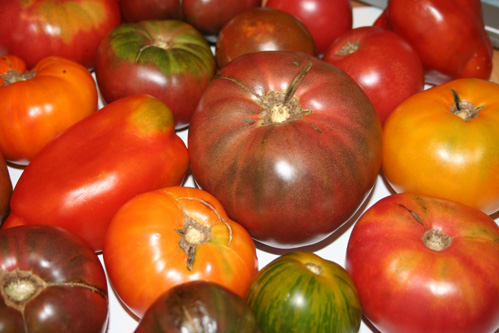
Varieties of Heirloom Tomatoes
Example of Sicilian Lemon
There are no genetically modified foods in Serbia, however both fruits and vegetables have unique phenotypes pertaining to the area. Color, shape, size, taste are all observable phenotype differences. For example: tomatoes in Serbia are slightly different than the same variety in Mexico. Why is this so? The environment the tomatoes are grown in directly affects the characteristics of the fruit. Climate, soil, chemical exposure, and other factors influence the dominant genes of the fruit. Plants, unlike humans are affected not only by their direct "parents" but also by the surrounding area. The same or similar genetic mutations take place because of the environment. Bees or birds spread the pollen of the plant, resulting in an area with similar phenotypes. Slight differences in temperature or soil acidity will affect the phenotypes. Over time, entierly new species are developed.                              
Thai Lemon


Sites:


Monday, January 10, 2011

Genetics

1. What are we talking about when we say "genetics"?

Genetics study genes and organisms. Genes are the hereditary traits you inherit from your parents and other ancestors. Anyone you are related to by blood can share genes with you. Genes are patterns in you DNA codes. Genes determine everything from you hair color, life span, and personality. Everyone has both dominant and recessive genes. Dominant genes are the ones that affect your personality and apperence. Recessive genes do not effect you but are passed on to your descendants. For example if two parents have dark hair and they have a blond child that means blond hair is a recessive gene. Another factor in your genetics is epigenetics. That is when the environmental effects your genes. If you are exposed to harmful substances in your environmental then it triggers harmful recessive genes. The time 9 months before and 6 years after a baby is born are the most crucial years in development. Cancerous mutations are a threat.

Burning Questions:

What do we not/ cannot clone humans?
Why does color change over time?
How do drugs or other harmful substances change your genes?
Do instincts have to do with genetics?
How does blood transfusion affect your genes?

5 Traits Deterimined By Genes:

  • blue eyes (eye color)
  • height
  • allergies
  •  personality (how calm, hyper, creative... ect. )
  • immune system

Tuesday, November 16, 2010

Chemistry Tools

Chemistry tools are quite varied. Multiple tools for heating, protracting, and containing the substances. Above is an image of just of a few tools used commonly in labs and classrooms.

Monday, November 15, 2010

Burning Issues in Chemistry

Global warming, waste management, and recycling are all issues we are familiar with. Chemistry is key in changing our past mistakes into cures for our Earth. The ICCA (International Council of Chemical Associations) Their pressing issues involve "green chemistry" specially designed not to emit hazardous waste. The American Chemistry Society is using cigarette butts to protect oil tankers against rust. This normally costs the companies millions but with cigarettes dissolved in water they can cut the cost by nearly 100%. 9 chemicals including nicotine are responsible for this value. Nearly 4.5 million cigarettes are dumped a year onto the ground. Besides looking horrible they poison fish because when it rains the runoff goes into the water. I believe another issue could be added to the mix, nuclear waste and plant management. It is more efficient to process energy from these plants. If scientists could find a way to make them more reliable and safe then we would reduce our carbon output.  Currently, working in a nuclear plant is shown to cause cancer from breathing in the fumes. One must mine the heavy elements, also causing lung damage. Nuclear waste has no safe way of being contained. In the U.S. all they do is bury it under ground. For 60 years the amount of waste has been building up. The waste is unsafe to be released into the world. Chemists should come up with a way of neutralizing the effects of the waste. 

Friday, November 12, 2010

"Intersex" Fish Found in Susquehanna River

 http://www.baltimoresun.com/features/green/bs-gr-fish-20101102,0,4595447.story

In Pennsylvania, US,  "intersex" fish are cropping up. These male small mouth bass have female traits. Over 90% tested have immature eggs. Scientists are looking into this abnormality of nature. What is causing these mutations? Arigcultural run off or consumer products such as medicines are linked to it. Vicki Blazer, a fishery biologist with US Geographical Survey, has seen other cases like this when studying the Potomac watershed. It came to her attention when she was studying bacterial infections in the fish. Not only are they mutating but newly hatched fish are dying.  Blazer links this to hormonal chemicals dumped around agricultural and developed areas. Herbicides containing atrazine is a main culprit. Syngenta, a company that produces it claims that tests from the 1970's show that it does no harm to the fish. To solve this troubling dilemma scientists are studying fish chronically exposed to chemicals in herbicides and other pollution.

To progress further in research scientists need to conduct more tests with  chemicals and how they affect fish. The article also mention that there may be a direct link to a change in diet.

Thursday, November 11, 2010

Absolute Zero: Part 1


Today in science class we watched the video Absolute Zero about the cold: what it is, how people perceived it in the past, and some of the unique properties. This documentary is named so because absolute zero is the coldest temperature there is.  There were many interesting facts about how early scientists developed theories on the cold. One of the more strange yet incorrect theories is about calhors, a mysterious "element" in the 1700s which invisibly made things cold. Since then we have developed a long way in our understanding. The cold is the lack of atomic movement; heat is movement. Important inventions such as the refrigeration, flash freezing, steam engine, and air conditioner were all developed by manipulating the temperatures of our surroundings. In modern times scientists strive towards the goal of creating absolute zero, which is not found in nature. Strange properties are attributed to matter when it becomes super frozen. A new state know as Einstein Bose Condensation is where matter is cooled so much it looses "self awareness" or shape. You cans slow down a beam of light using this property. There are still some questions I have regarding this documentary. Is there an absolute hot? If not, then what is the hottest temperature recorded? Do atoms have special properties when they are heated to high temperatures? Do all refrigerators use ammonia? If so, why?

Monday, November 1, 2010

Phases of Matter

There are three common states of matter. They are solids, liquids, and gases. You see them everyday in the form of air, water, trees, ect. All matter fits into one of the these categories. One of the lesser known phases is plasmas. What are these types of matter like? Solids have their molecules most pact together. They cannot move around. Solids can be rocks, trees, metal, ect. Liquids have molecules that are less pact than a solid. They spread to fill a container that they are poured into; their is no definite shape. When poured onto a surface liquids spread across it. Gases have the least compact atoms. There is no definite shape to a gas. Some examples are oxygen in the air and water vapor. Plasmas have free floating ions and electrons. Plasmas conduct electrical currents. They are found in stars such as our Sun.
How is one phase of matter different from another one?
Phases of matter differentiate by their compactness. Solids are the most compact and gases (including plasmas) are the least. Liquids are in between. Because of the space between the atoms this allows more movement. Gas atoms are more active than solid ones. Gases are also hotter than solids. Atoms are more active when they are heated. Solids must be naturally cooler than liquids or gases.

My Tests:
Emiak and I are going to design three tests to determine if the matter is solid, gas, or liquid. (Plasma is too hard.)First of all we will determine if the matter is solid. To do this we will smash the matter.
Materials
ice cube
water
air from our lungs
bowl

Wednesday, October 27, 2010

Flame Test

A flame test is a method in chemistry to find certain metal ions in a solution. Each type of metal ion produces a different colored flame (it also depends on the temperature of the fire). Elements are heated in a Bunsen burner to produce flame. The metal ions become excited by the heat, this causes them to turn into atoms. They then produce visible light.

After the Experiment:
Emika and I did the flame test with nine different elements/compounds. We used about a teaspoon of every compound. Then we lit the gas Bunsen burner. We used a metal holder to put the element directly into the fire.  They produced flames ranging from magenta to green to orange. Most were partially or completely green. This may because of chloride content. The compounds that produced a green flare were calcium chloride, copper chloride, iron filings, and potassium chloride. Three of the four have chlorine, a common pool cleaning agent, characterized by its greenish color. However, lithium chloride made magenta-orange flames when burned. Borax made orange flames and so did sodium carbonate. Borax is also known as sodium borate. Maybe the sodium in borax and sodium carbonate produces the orange flames.

Monday, October 25, 2010

One World Essay About Water Pollution

Water Pollution
The Deadly Crisis
By Emma Moore

He is only 3 years old. He has only days left. Every day millions of children like this die from dehydration. Why? Because of our mindless dumping of pollutants into the Earth’s water systems. Children have to walk miles just to get adequate water. It’s so simple to turn on a tap and get all the water you want. We forget the people who die every day because they do not even have a drop. Millions die every year from dehydration. We need to stop this outrage, today. This first step is to cut down on water pollution.

H2O commonly known as water, is everywhere from the ocean to clouds to our bodies. Without water, life would be impossible. It is clearly the most precious resource on Earth. Formed by the bonding of an oxygen atom with two hydrogen atoms, over 70% of the globe is water. 75% of it is salt water while the rest is locked up in ice caps. This leaves only around 1% left for drinking water. However, due to a combination of industry, agriculture, and private uses, our supply of this essential substance dwindles. Over a billion worldwide do not have access to this basic amenity. That is roughly one out of every six people.

Water pollution is defined by any human-caused contamination of water that reduces its usefulness to humans and other organisms in nature. Pollutants can range from grass clipping to sewage run off to radioactive waste. They are divided into two types, point source and non-point source. Point source pollution is emitted directly into the water. For example, the BP oil spill is a point source. Non-point source pollution indirectly poisons the environment. An example of this would be agricultural runoff which flows through streams killing aquatic life. Non-point sources are much more difficult to control because there are no obvious starting places.
There are numerous causes of water pollution.

One of the most common non-point source pollutants is sewage and fertilizer runoff. They contain nitrates and phosphates which algae transform into a form of energy. This reaction uses oxygen in the water which aquatic life needs to breathe. Overgrowth causes the algae to clog waterways. When the supply of food runs out they die, falling to the bottom. Fish suffer respiratory problems from the lack of oxygen. Algae also blocks sunlight from entering the water bed. Animals and plants die unnecessarily. This causes disruptions in the food chain ensuring further deaths from starvation. The same thing happens with other organic runoff such as grass clippings and livestock feedlots.

One of the most deadly pollutants are pathogens: bacteria, viruses, and protozoan. Though microscopic, these disease vectors are responsible 5 million deaths a year. The majority are young children. Untreated sewage, storm drains, farm runoff, and septic tanks are all carriers of pathogens. Drinking water contaminated by pathogens often causes chronic illnesses if not death. Typhoid fever, dysentery, skin and respiratory problems can all be linked to it.

Remember last April? The world was horrified by news of an leak gushing out tons of crude oil into the Gulf of Mexico. B.P. was drilling on April 20 th when it happened. It is estimated that so far 8 million gallons have spread through the ocean and more is coming. Petroleum leaks are the most ecologically damaging. Countless creatures who live by or in the sea die from poisoning. Because oil and water do not mix, petroleum can rapidly flow across the ocean. Wild animals do not know to avoid the oil spills. Dolphins can be seen eating, playing, and sleeping in oiled areas. Efforts to halt oil leaks just damage the sea more. Chemically treating the spill with dispersant just kills more aquatic life and spreads the oil further below the surface. They may be aimed to prevent concentrated spread to the shore. However, dispersants are generally ineffective. They do not clean the oil on the water, merely breaking it down and sinking it to the bottom. There are many types but they all contain a solvent and a solution. Planes spray down the dispersant onto the oil slick. The solvent carries the solution down into the oil. The Type 1 dispersant is a hydrocarbon solvent sprayed onto the oil at the surface of the water in the Gulf. Another type of dispersant is made up of alcohol and glycol in a higher concentration.

Despite all the damage that is being done, organizations across the globe are making an effort into preserving our water supply. The United Nations had formed U.N.E.P. (United Nations Environmental Program). Their goal is to provide access to sanitary water for all by 2015. While this may not happen, so far they have spread programs from 22 countries to 88. The Clean Water Act of 1970 prevents factories from dumping waste. This deals with point source which can be easily traced. Non-point sources, like the examples in the above paragraphs, are harder to trace.

We have gotten off to good start, but this is not enough, you, yes you need to act, starting today. Do you want your children to live in a world without clean water? Do you want to? Recycle! When they are produced most factories that make your materials pollute. Reduce! Try to bike or walk as often as you can. Emissions from cars go up into the atmosphere then rain down upon bodies of water. Reuse! Packaging often contains harmful dyes. Factories that produce the packaging let out poisonous emissions. If you make smart choices everyday you can ensure sanitary water throughout your life.

As you can see, water pollution is a major issue. Everyone needs to pitch in and reverse society’s mindless poisoning. I believe that saving our water supply is an urgent cause. What else do we depend on so heavily for life? Humans can only last days without water. We need it for sanitation, drinking, and recreation. Anyone who poisons water systems must realize they will eventually poison themselves or their home, the Earth. We can all make a difference, it just takes work.

Hydrogen Compounds